High-mountain traverse July 2026
Integral Sierra Nevada
Sierra Nevada · Andalusia, Spain
A four-day traverse across Sierra Nevada, with bivouacs, mountain shelters and fifteen 3,000-metre peaks along a route of rocky ground, long ridges and shifting weather.
The experience
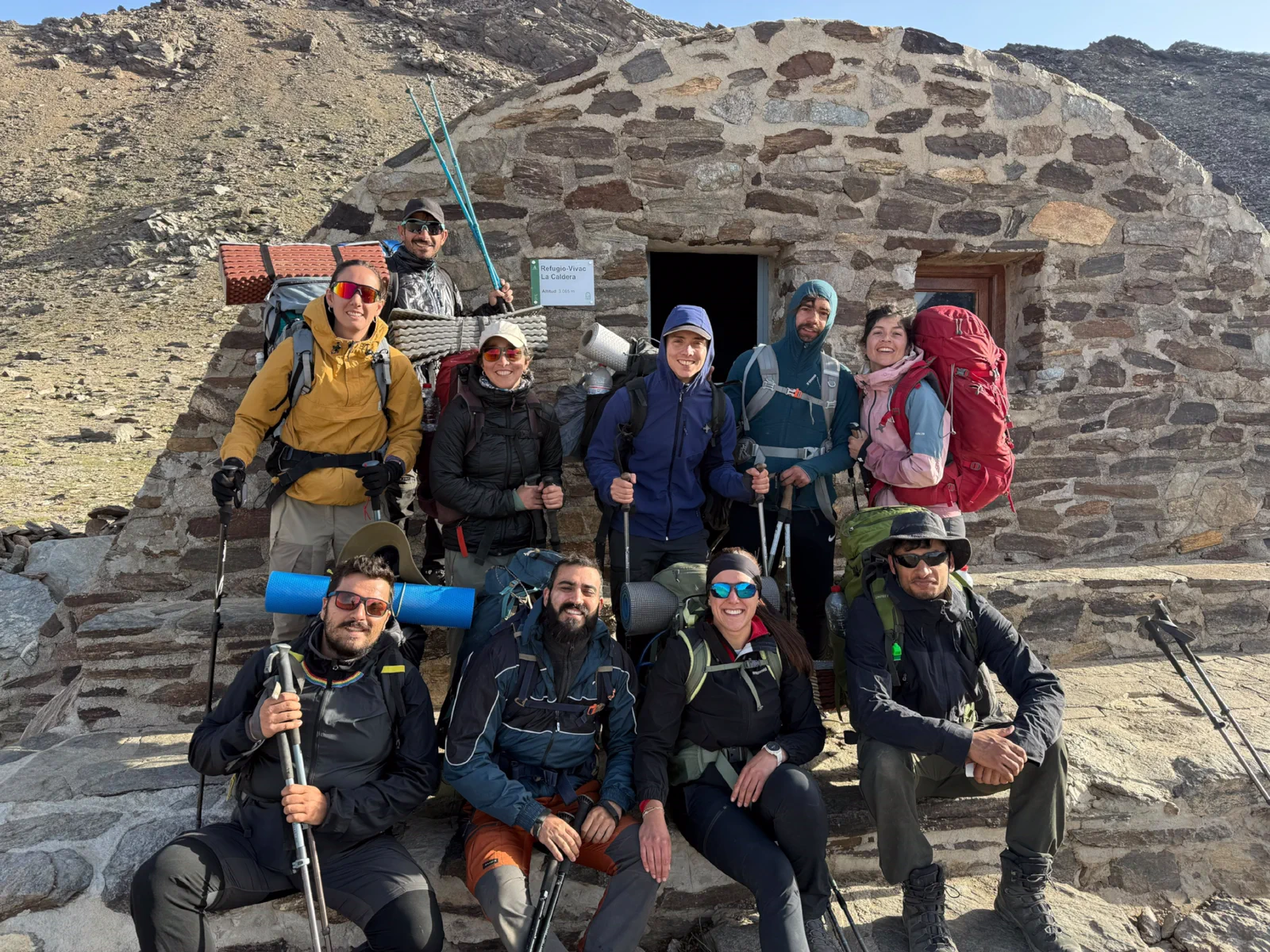
The Integral began several months before we ever set foot in Sierra Nevada. We were a large group, and a multi-day traverse required coordinating cars, food, water points, equipment and escape routes. We spent the previous day completing that logistics plan, preparing our packs and climbing to the Picón de Jérez refuge, where we spent the first night before the traverse truly began.
The first stage started with the summit of Picón de Jérez and immediately made clear how demanding the following days would be. Two members assessed the pace, elevation gain and everything that still lay ahead and decided to turn back. The rest of us continued linking three-thousand-metre summits until we reached Laguna de Vacares. That evening I slept outdoors in the mountains for the first time, beneath a completely clear sky filled with more stars than I could remember seeing before.
The following morning brought one of the most technical sections of the traverse: Puntal de Vacares. The terrain became a succession of large rock blocks, with no obvious trail and a constant need to choose the best line. One member of the group placed his foot badly and twisted his ankle. The injury did not appear serious; I was carrying an emergency bandage, so we stabilised it and he managed to complete the stage. The next morning he used one of the escape routes that had been planned from the outset, accompanied by another member who had also decided that she had reached her limit.
That same day we reached Mulhacén, the highest point on the Iberian Peninsula and one of the summits I had most wanted to experience. The wind intensified during the ascent and descent, with gusts strong enough to throw us off balance. When we reached La Carihuela refuge it was already full, so we had to sleep outside. My second bivouac night passed with almost no sleep: the wind hammered against the sleeping bag and I even had to weigh down my backpack with rocks to keep it from being blown away. Above us, however, the sky remained completely clear and full of stars.
The third stage covered more than twenty kilometres, taking us over Veleta and several other three-thousanders before we passed Elorrieta refuge. It was full as well, and continuing towards the Cerro del Caballo bivouac refuge meant accepting that there might not be room there either. Some members of the group were carrying considerable fatigue and needed to sleep under shelter, so we continued. When we arrived, a family already there shared both space and even some of their cooking gas. With careful organisation, those who most needed to recover could sleep inside while four of us stayed outside beside the lagoon.
That final night could hardly have been more different from the previous one. With no violent wind battering the camp, shooting stars appeared above us while conversation and laughter continued until we eventually fell asleep. The following morning only the long descent towards the cars and Lanjarón remained. Four stages, fifteen three-thousand-metre summits and several nights at altitude had passed, yet the strongest memory was not a number or any single summit. It was the way a group of people kept adapting, helping one another and making decisions together so that a traverse planned for months could reach its end.
Route highlights
- Picón de Jérez, Puntal de Vacares, Mulhacén and Veleta
- Three nights of bivouacs and high-mountain shelters
- Fifteen 3,000-metre peaks across three days
Visual selection
Moments from the activity
Reference track
Download GPX
This file provides a reference track and elevation profile for the itinerary. Conditions change: check maps, forecasts, equipment and your plan before setting out.